Train your own
Your conversations → your private dataset → one GPU job → a model that is yours, back on the phone. The app does the plumbing; Hugging Face does the compute and bills your account per minute.
Models › Train your own. Needs a Hugging Face write token in Settings › Hugging Face and at least one dataset you shared from History.
What happens
- Dataset — pick one you shared (History › Share to Hugging Face). The app reads the shards and counts the conversations.
- Recipe — base
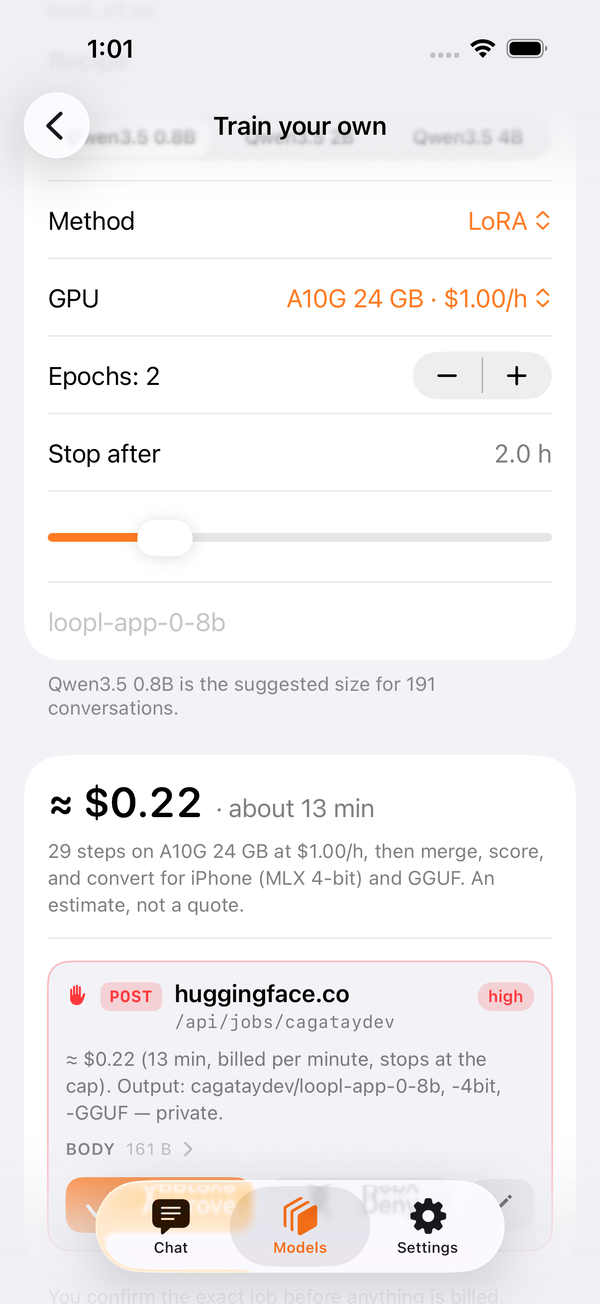
Qwen3.5 0.8B / 2B / 4B(suggested by dataset size: < 300 → 0.8B, ≤ 2 000 → 2B), LoRA or full fine-tune, GPU, epochs, and a hard stop in hours — Hugging Face kills the job there, so the cap is also the most it can cost. - Estimate — steps × measured seconds-per-step on that GPU, plus install, scoring and the two conversions. Honest, not a quote; it leans long.
- Confirm — the same approval card the agent shows for an
httpcall:POST huggingface.co/api/jobs/<you>, the flavor, the cap, the script arguments. Deny and nothing is sent. - Job — the app commits
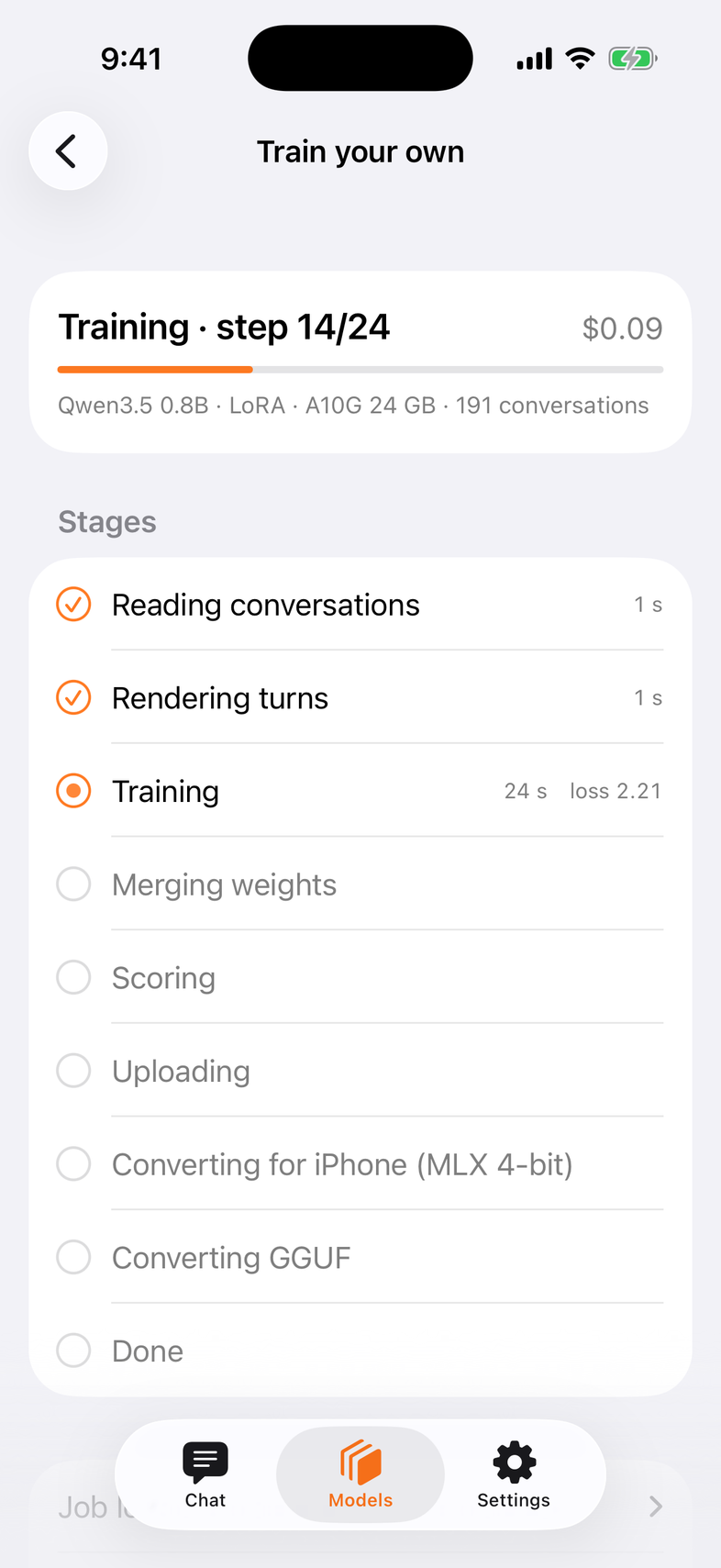
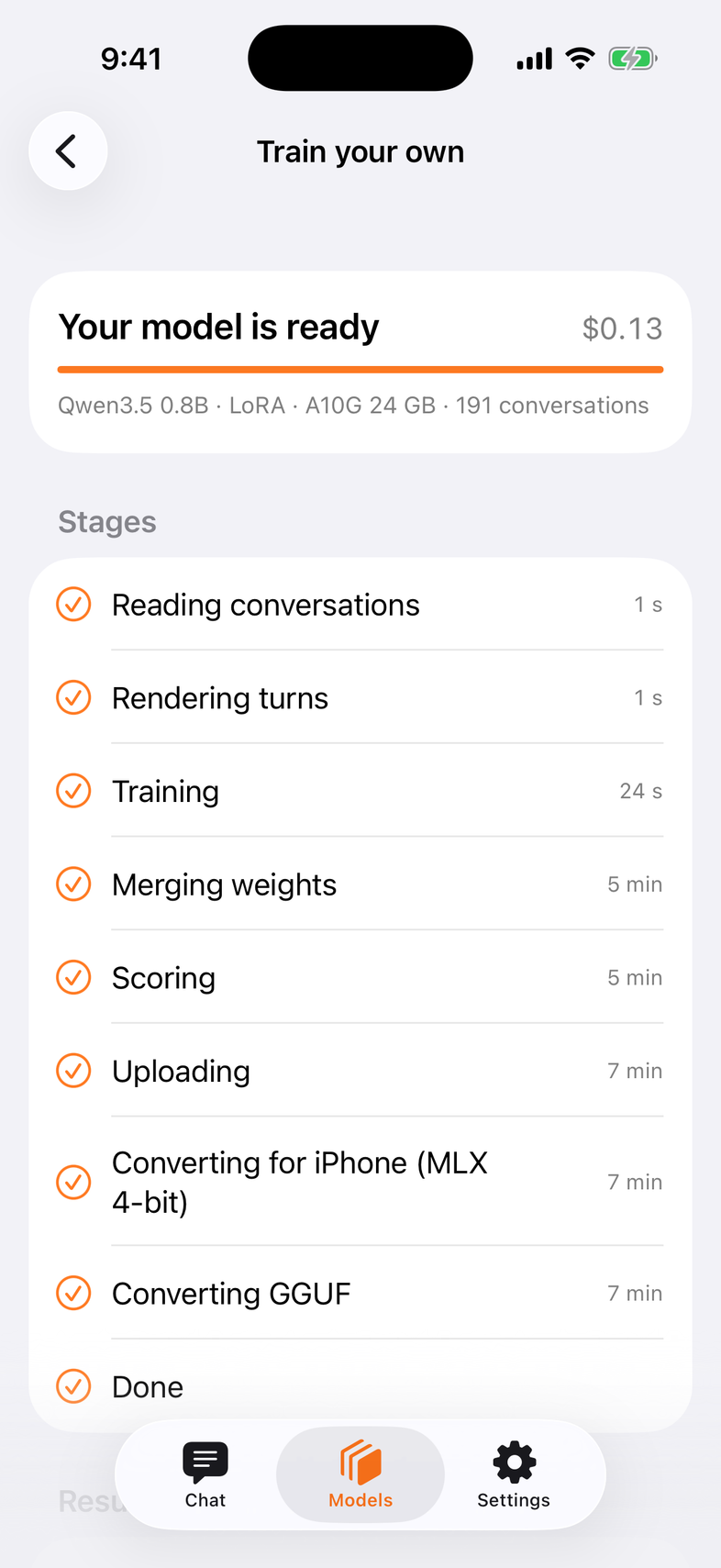
train/loopl_sft.pyinto your dataset repo and launches it withuv run. The script trains, merges, scores on held-out conversations, pushes<you>/<name>(weights),-4bit(MLX, for the phone) and-GGUF— all private. - Result — eval loss before → after, how often the tuned model picked the right tool, and Add to Models. The repos also appear under Models › Mine.
Keep going — rounds, epochs, stitching
A tuned model is a base too. Three controls on the Recipe card make training a thing you keep doing rather than do once:
- Continue a model. Pick one of your Mine models and the next job trains on top of it — round 2, round 3… The badge tells you the round; the model card
carries the whole lineage (
Qwen3.5-0.8B → loopl-app-sim → loopl-app-sim-r2). The script trains from the bf16 twin of the 4-bit model you run on the phone — training from 4-bit weights is refused, and a model without a bf16 twin is named as "can't continue". Round ≥ 2 defaults to LoRA (r32, lr 5e‑5) and replays every shard of the dataset so round 1 is not forgotten; turn Include all previous shards off to train on the new ones only. - Epochs: Auto (recommended). Up to 3 passes, scored on held-out conversations after each; the checkpoint with the lowest loss is kept and training stops the moment loss rises. The guide the footnote shows is the one we measured: under 200 conversations 3–4 · 200–1 000 → 2 · over 1 000 → 1–2. Pick 1–4 by hand when you know better. The result card draws held-out loss per epoch and marks the epoch that was kept.
- Stitch related conversations. By day joins the chats you shared on the same day — oldest first — into longer multi-turn samples (several per day when a day is long), so the model learns to carry context across chats; By topic joins chats about the same thing. Tool call / result pairs always travel together; the originals train too. The footnote previews how many stitched samples your dataset yields.
Measured, round 2 from the app: base loopl-app-sim (itself trained from the app), 74 conversations stitched by day, epochs auto → 3 trained, best epoch 2 —
A10G, 334 s, ≈ $0.10, held-out loss 0.58 → 0.22, tool calls 12/12, vision kept. The result lists in Mine as round 2 and can be continued again.
Cost guide
| base | GPU | 200 conversations | 1 000 | 5 000 |
|---|---|---|---|---|
| 0.8B LoRA | A10G $1.00/h | ≈ $0.25 · 13 min | ≈ $0.50 · 30 min | ≈ $1.90 · 1.9 h |
| 2B full | A100 $2.50/h | ≈ $0.80 · 20 min | ≈ $2.30 · 55 min | ≈ $10 · 4 h |
| 4B LoRA | A100 $2.50/h | ≈ $1.00 · 25 min | ≈ $2.80 · 1.1 h | ≈ $12 · 5 h |
Measured: 191 conversations, 0.8B LoRA, 2 epochs on an A10G — 8 min, $0.13, held-out loss 2.38 → 2.15. With pictures: 74 conversations (14 with images), 0.8B LoRA on an A10G — 6 min, ≈ $0.10, held-out loss 0.75 → 0.29; the result shows up in Mine with its vision badge and describes photos on the phone.
Vision is kept, not tuned. The export keeps the base model's vision tower, so a model trained from conversations with pictures still sees; the training itself learns from the text of those turns.
For SDK users
TrainingPlan → TrainingEstimate; TrainingLaunch.jobSpec builds the job body; TrainingSession uploads the script, creates the job through HFHubClient and polls TrainingProgress (the script's [loopl] stage=… lines). The token travels only as the job's HF_TOKEN secret. The training script lives in loopl-train (train/loopl_sft.py ≥ 1.1.0 — the MLX export keeps the vision tower), bundled with the app byte-for-byte.